
The Unseen Force: Mastering Greenhouse Airflow with HAF and VAF Systems
A misunderstanding of greenhouse airflow management is a direct impediment to production, leading to inconsistent crops, rampant disease, and staggering energy waste.
At the core of this failure is a simple confusion between two distinct processes:
Ventilation: Exchanging inside air for outside air to manage heat and humidity.
Circulation: Moving and mixing the air within the greenhouse to create a uniform microclimate.
You can have a state-of-the-art ventilation system and still fail if your internal circulation is flawed. Mastering this "unseen force" is the key to unlocking your crop's full genetic potential.
Greenhouse Airflow: Key Takeaways for Growers
Based on extensive analysis of circulation technology and common grower pitfalls, here are the essential takeaways for optimizing your operation:
Circulation Is Not Ventilation. The most common error is confusing the two. Greenhouse circulation fans (HAF/VAF fans) homogenizes the internal air; ventilation (exhaust fans/vents) replaces it. Running both at the same time is a costly mistake.
HAF is the Primary Driver. Horizontal Air Flow (HAF) systems are the industry standard for a reason. They are highly efficient at creating general temperature and humidity uniformity in most standard greenhouses.
VAF is the Specialist. Vertical Greenhouse Airflow is a problem-solving tool. It is not a replacement for HAF. Its purpose is to solve specific, high-value problems like thermal stratification from supplemental lighting or humidity pockets in dense canopies.
Your Biggest Loss is "Downtime." The biggest "performance gap" isn't the fan technology; it's the lack of controls and maintenance. A dirty fan or a "dumb" control system can cut your efficiency by 30-50%, wasting thousands in energy costs.
[Image: Comparison of HAF and VAF greenhouse circulation fans designed to solve specific thermal stratification and greenhouse airflow challenges.]
Why Still Air is a Crop Killer
For a plant, the air is a resource pool and a potential threat. When that air is stagnant, the biological consequences are severe. Investing in greenhouse airflow is a direct investment in crop health.
Temperature Chaos: Without circulation, air stratifies. Hot air rises, and cool air settles. It's common to find 10-15°F differentials across a single house. This leads to disastrously uneven growth rates and unpredictable crop timing. A good air circulation system cuts this differential to as little as 2°F.
The Disease Vector: High humidity is the enemy, but the real danger is condensation. On a cool night, a leaf's surface can drop below the air's dew point. This creates a thin film of water - the perfect breeding ground for Botrytis (gray mold) and powdery mildew. Circulation breaks the stagnant boundary layer around the leaf, keeping its temperature in line with the air and preventing condensation from ever forming.
Photosynthetic Starvation: Plants consume CO₂ for photosynthesis. In still air, a plant quickly uses up the CO₂ in the air immediately touching its leaves, creating a "depletion zone". The plant effectively starves, even if your overall greenhouse CO₂ level is adequate. Circulation constantly sweeps this depleted air away, replacing it with CO₂-rich air and maximizing photosynthetic efficiency.
The Workhorse vs. The Specialist: HAF and VAF greenhouse circulation fans
The most common question from growers is: "Which fan do I need?" The answer depends entirely on the problem you are trying to solve.
1. Horizontal Greenhouse Air Flow (HAF): The Uniformity Workhorse
For decades, HAF has been the dominant technology, and for good reason. The system is elegantly simple:
The "Racetrack" Principle: HAF fans are arranged to get the entire mass of air in the greenhouse (which can be 1.5 tons or more in a 30x100 ft house) moving in a slow, circular "racetrack" pattern.
High Efficiency: Once that mass is moving, it takes very little energy to keep it rolling. The goal is a gentle, persistent flow of 50-100 feet per minute, which is all that's needed to mix the air from floor to ceiling.
The Benchmark: Brands like Vostermans' Multifan have become the industry standard, engineering fans with corrosion-resistant materials and IP55-rated motors to survive the high-humidity greenhouse environment.
Bottom Line:
For most bedding plant, plug, or standard-profile vegetable operations,
HAF is the most cost-effective solution
for achieving the general temperature and humidity uniformity required for a high-quality, even crop.
[Image: Image]
2. Vertical Air Flow (VAF): The Stratification Specialist
VAF technology (like the Multifan V-FloFan) is a newer, more specialized tool. It is
not
designed to create a general circulation pattern. Its function is to
aggressively combat vertical stratification
.
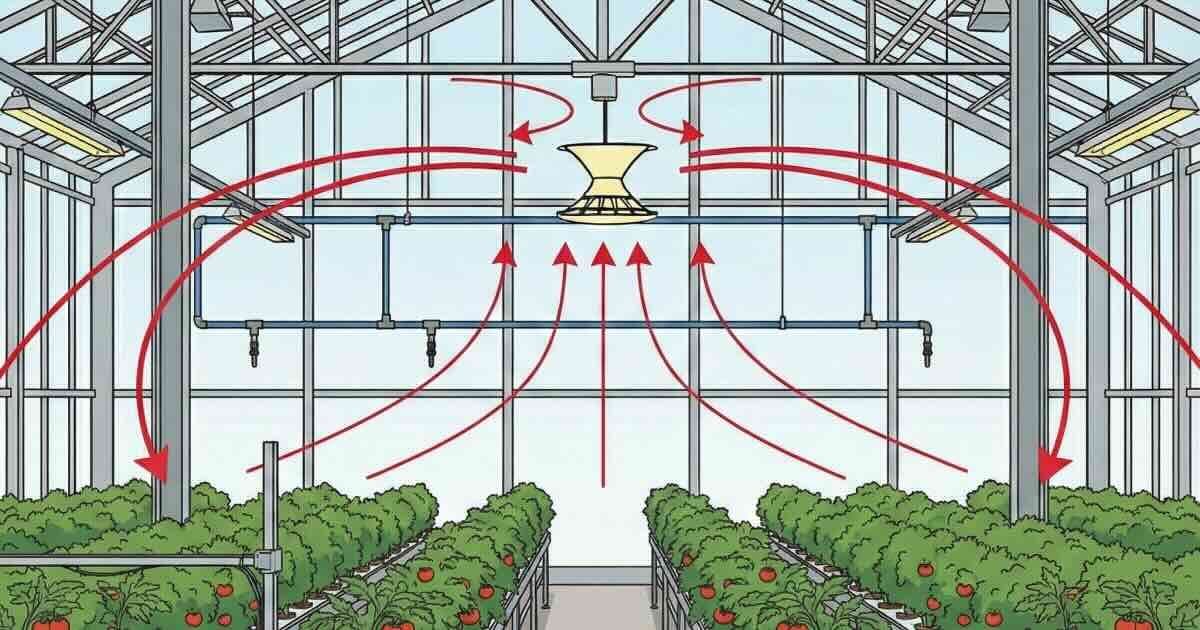
These greenhouse circulation fans pull hot, dry air from the greenhouse peak and push it directly down into the crop. This solves two specific, high-value problems that HAF systems struggle with:
Sample 1: Vining Crops (Tomatoes, Cucumbers)
The Problem: High-intensity supplemental lights (assimilation lighting) produce immense heat, which rises and gets trapped in the ridge, high above the crop. Meanwhile, your heating system at floor level works overtime to keep the roots warm.
The VAF Solution: VAF fans grab this "wasted" heat from the lights and force it back down to the plant level. At Intergrow Greenhouses in New York, a VAF system created a more even temperature and resulted in significant heating cost reductions by recirculating this trapped thermal energy.
[Image: Vaf circulation scheme demonstrating commercial greenhouse airflow]
Sample 2: Leafy Greens Greenhouse Airflow Solution.
The Problem: Dense canopies of high-density crops like lettuce trap moisture, creating a pocket of near-100% humidity inside the plant. This stagnant air stops transpiration, which in turn stops the flow of calcium to the plant's new growth, causing crop-destroying "tip-burn". HAF, moving air above the crop, can't penetrate this dense canopy.
The VAF Solution: The downward blast of air from a VAF fan is the only thing that can effectively penetrate the lettuce head, disrupting the humid boundary layer and promoting transpiration. This is a high-cost fan, but it solves a multi-thousand-dollar crop-loss problem.
Quick-Decision Guide for Greenhouse Airflow: HAF and VAF and Hybrid
Swipe the table sideways to see more →
Crop Type | Greenhouse Height | Primary Climate Challenge | Recommended System | Rationale / Key Considerations |
|---|---|---|---|---|
Bedding Plants / Plugs | Low (<12 ft) | General temperature & humidity uniformity | HAF | HAF provides the most cost-effective and efficient method for creating a uniform environment in lower-profile greenhouses with less dense canopies. |
Vining Crops (Tomatoes, Cucumbers) | High (>12 ft) | Thermal stratification from lighting; canopy humidity | Hybrid (VAF + HAF) | VAF is essential to destratify the tall air column and recirculate heat from assimilation lights. HAF provides supplemental horizontal movement along the long rows. |
Leafy Greens (Hydroponic Lettuce) | Low or High | High humidity within the dense canopy; tip-burn prevention | VAF | VAF is critical. Its downward greenhouse airflow is necessary to penetrate the dense plant canopy, disrupt the humid boundary layer, and promote transpiration to prevent tip-burn. |
Cannabis | Medium to High | Dense canopy humidity; temperature stratification from lighting | Hybrid (VAF and HAF) | VAF helps manage heat from high-intensity lights and drives air into the dense flower canopy to prevent mold. HAF ensures overall air exchange throughout the facility. |
The Great Performance Gap: Why Your Fans Aren't Working (And How to Fix It)
The hard truth is that many growers who have invested in high-quality fans are still getting poor results. The technology isn't failing; the implementation is. This "performance gap" is where most operations are losing money, and it almost always comes down to three failures.
1. The Cost of "Dumb" Greenhouse Airflow Controls
The most frequent and costly error is a failure of control.
The Cardinal Sin: Running your HAF greenhouse circulation fans at the same time as your main exhaust fans. The two systems fight each other, creating energy-wasting turbulence and completely destroying the cooling efficiency of your ventilation system. At a minimum, HAF fans must be interlocked with a power relay to shut off automatically when vents or exhaust fans are activated.
The VFD Solution: The next step is moving from simple on/off to Variable Frequency Drives (VFDs). This is a non-negotiable for modern efficiency. The Fan Laws of physics state that a fan's power consumption is proportional to the cube of its speed. This means a tiny 20% reduction in fan speed can cut power consumption by nearly 50%.
Case Study: Len Busch Roses in Minneapolis had a system that blasted fans on and off in stages, causing wild 50% humidity swings. Retrofitting with a VFD allowed them to ramp all fans up and down smoothly, eliminating the humidity swings, reducing equipment stress, and stopping noise complaints.
2. The Maintenance Deficit
Maintenance is consistently seen as a low-priority task, yet it has a massive impact on performance.
The 30% Loss: According to university extension guides, just a few ounces of dust on fan blades can create an imbalance that reduces operating efficiency by as much as 30%.
The 30% Gain: A research study found that simply cleaning guard screens and adjusting fan belts to their proper tension increased greenhouse airflow by over 30% while simultaneously decreasing power consumption by 20%.
The Takeaway: You are paying 100% of the electricity bill for 70% (or less) of the intended greenhouse airflow. A formal, scheduled cleaning program is not a cost center; it is a profit-enhancing activity.
3. Common Greenhouse Airflow Design & Installation Pitfalls
Even the best fans will fail if installed incorrectly. These are the most common grower mistakes:
"Short-Circuiting": Spacing fans too far apart (e.g., > 50 feet). The airstream loses momentum and "short-circuits" to the opposing line, creating large, stagnant "dead zones" that are prone to disease.
Incorrect Aiming: Intuitively, growers often aim HAF fans down at the crop. This is wrong. It breaks the horizontal "racetrack," fails to create a uniform house-wide mix, and can dry out pots and foliage unevenly.
Improper Placement: The first fan in a line should be 10-15 feet from the endwall to "catch" the air coming around the corner. Mounting fans too close to a wall "chokes" their intake, slashing their real-world CFM output.
[Image: airflow patterns in a greenhouse equipped with Horizontal Air Flow (HAF) fans]
Your Action Plan For Profitable Greenhouse Airflow: From Theory to Profit
The greatest opportunity for most growers is not in buying new fans, but in better controlling and maintaining the assets they already possess.
Phase 1: Diagnose & Design Don't start with a fan catalog; start with a problem. Are you fighting tip-burn in lettuce (a VAF problem) or just general temperature variation in a bedding plant house (a HAF problem)? Use the industry-standard baseline of 2 CFM of fan capacity per square foot of floor area and adjust up for obstructions like hanging baskets or dense canopies.
Phase 2: Invest in Intelligent Controls Transform your greenhouse airflow from a simple on/off mechanical process into a strategic climate tool. Whether you are commissioning a new facility or modernizing an existing operation, the GrowDirector 4 PRO platform acts as an intelligent command layer that unifies your ventilation infrastructure.
Unify Your Infrastructure: Use the DryContactDirector smart relay module to automate your preferred high-voltage exhaust fans and motorized louvers, regardless of the brand.
Execute Sensor-Driven Logic: Move beyond basic thermostats by using the SensorDirector environmental hub to trigger air exchange based on precise real-time temperature, humidity, and VPD data.
Protect Your Assets: Ensure operational continuity with a distributed architecture that has no single point of failure, protecting your crop from heat buildup or humidity spikes. LEARN MORE - https://growdirector.com/
Phase 3: Make Maintenance Mandatory This is the easiest and cheapest money you will ever save. Implement a formal, recurring maintenance schedule. Prioritize the two tasks with the highest ROI: 1) Cleaning blades, guards, and motors; and 2) Adjusting belt tension. This alone can recover 30% of your system's performance and cut energy waste.
Read MORE:
Best Industrial Airflow Automation - https://growdirector.com/
Ventilation in greenhouses - https://www.dpi.nsw.gov.au/agriculture/horticulture/greenhouse/structures-and-technology/ventilation
Horizontal Air Flow is Best for Greenhouse Air Circulation - https://farm-energy.extension.org/horizontal-air-flow-is-best-for-greenhouse-air-circulation/
Ventilation in Greenhouses and High Tunnels – https://blog.uvm.edu/cwcallah/2019/08/14/ventilation-in-greenhouses-and-high-tunnels/
Energy-Related Agricultural Best Practices https://www.nyserda.ny.gov/-/media/Project/Nyserda/Files/Publications/Fact-Sheets/AG-bpvegvent-fs.pdf

![[Image: External ventilation intake and internal greenhouse airflow circulation systems in a commercial facility.]](https://growdirector.com/wp-content/uploads/2025/12/1967941949-—-средний-размер.jpeg)
![[Image: Comparison of HAF and VAF greenhouse circulation fans designed to solve specific thermal stratification and greenhouse airflow challenges.]](https://growdirector.com/wp-content/uploads/2025/12/1967941950-—-средний-размер.jpeg)
![[Image: Image]](https://growdirector.com/wp-content/uploads/2025/12/1967941951jn-—-средний-размер.jpeg)
![[Image: Vaf circulation scheme demonstrating commercial greenhouse airflow]](https://growdirector.com/wp-content/uploads/2025/12/1967941953.jpg)
![[Image: airflow patterns in a greenhouse equipped with Horizontal Air Flow (HAF) fans]](https://growdirector.com/wp-content/uploads/2025/12/1967941952.jpg)