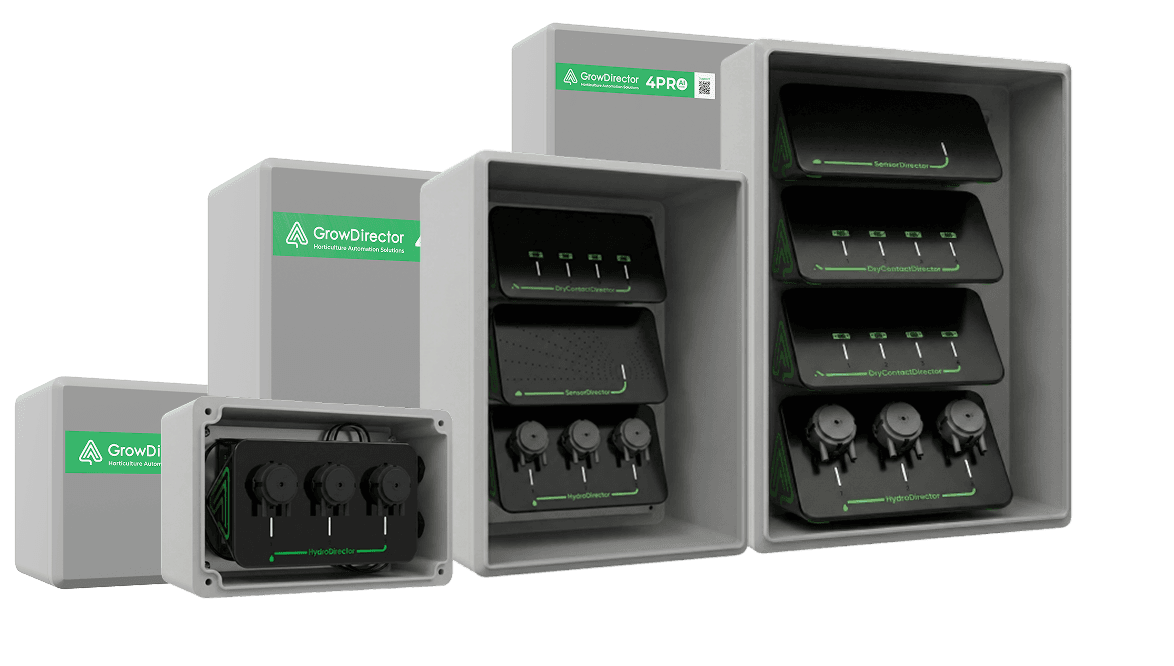
Compact
IP65 rated
For monitoring and dosing setups. A single enclosure at the tank or in the growing area, doing one job well.

Automation Kits
Сonfigure your GrowDirector solution quickly and easily
GrowDirector 4 PRO gives every greenhouse project the flexibility to meet its own growing and technical requirements. Every project has a unique configuration, and the modules combine the same industrial grade building blocks in different ways: nutrient dosing, water sensing, climate monitoring, soil moisture, and device control. The Solution Configurator narrows this down to your specific solution configuration through two questions any grower can answer in a minute: do you grow in substrate or in soil, and how large is your operation.
Two questions, one answer
Dosing, climate monitoring, and 4 controlled devices
Side by side
Every kit is a combination of four capabilities. The table shows exactly what you get, so you choose by capacity, the way you would spec any other piece of equipment on your farm.
| Kit | Nutrient dosing | Water sensors | Climate sensors | Soil moisture sensors | Devices controlled |
|---|---|---|---|---|---|
| HydroStarterGDK301 | 3 pumps | 3 | — | — | 0 |
| HydroProGDK302 | 3 pumps | 3 | 1 | — | 4 |
| HydroMaxGDK303 | 3 pumps | 3 | 2 | — | 8 |
| SoilControlGDK304 | — | — | 2 | 1 | 8 |
| DeviceControlGDK305 | — | — | 2 | 1 | 12 |
| ClimateSenseGDK306 | — | — | 4 | — | 0 |
Every kit arrives in a sealed industrial enclosure sized for its job, ready to mount next to the equipment it runs. No control room required.
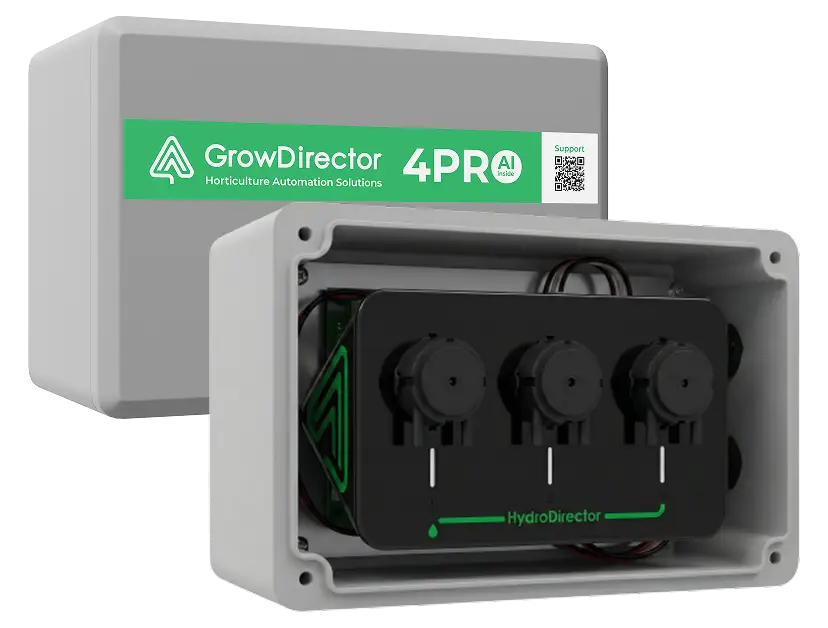
IP65 rated
For monitoring and dosing setups. A single enclosure at the tank or in the growing area, doing one job well.
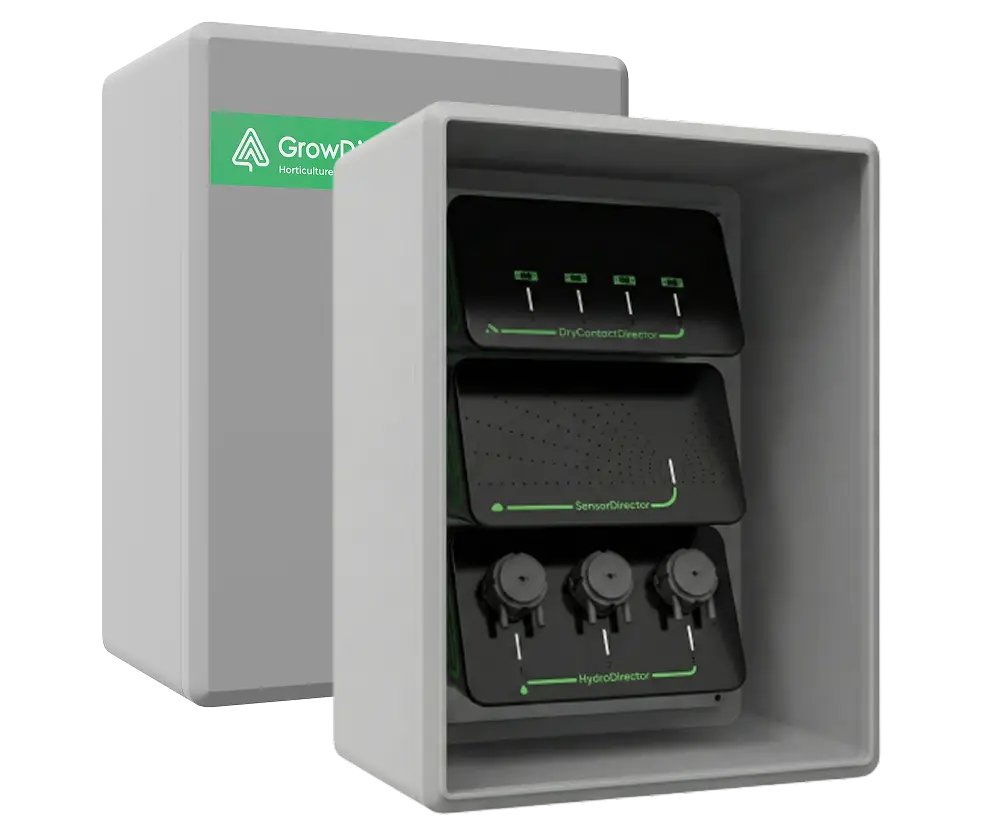
IP65 rated
For single zone automation. Dosing, sensing, and equipment control working together from one cabinet.
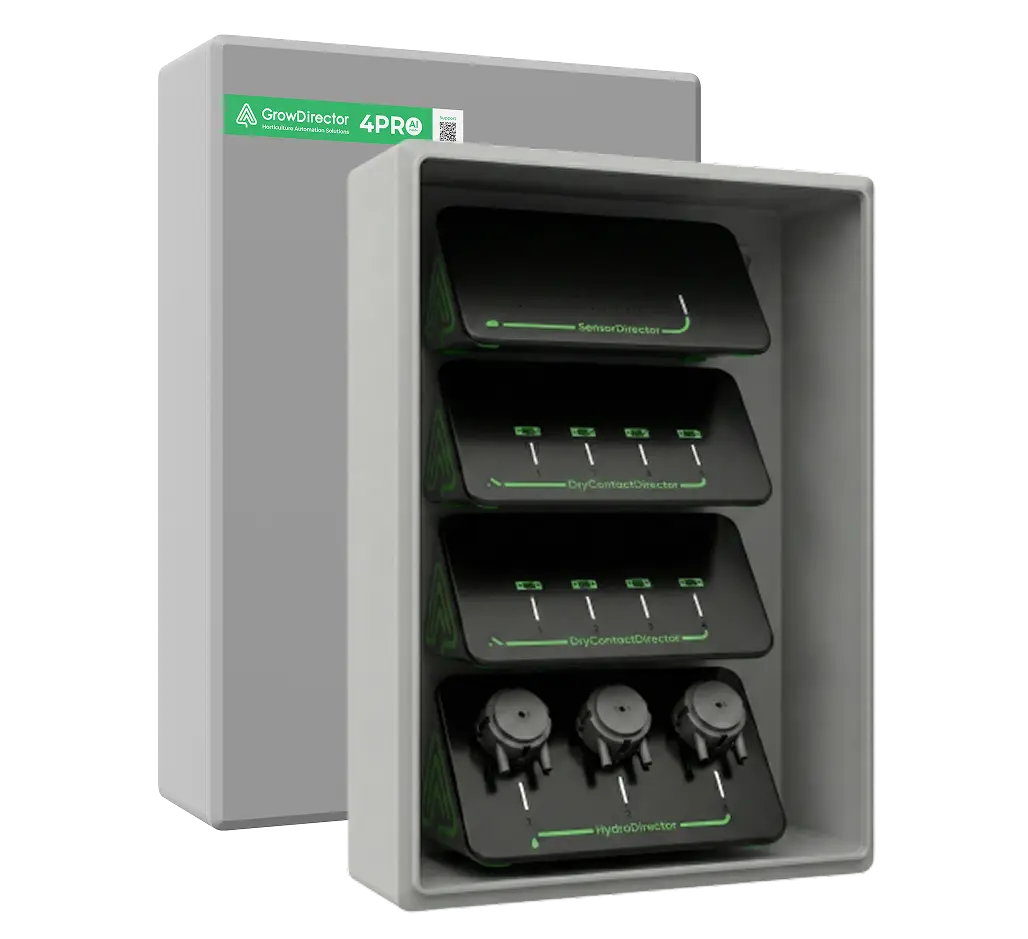
IP65 rated
For complete greenhouse automation. The configuration that runs dosing, climate, and the full equipment list of a commercial operation.
HydroStarter is the entry point into hydroponic automation and is built around a single job: keeping the nutrient solution stable without the grower testing it by hand. Three built in dosing pumps deliver nutrient and pH adjusting solutions on a schedule or in response to live readings, while industrial grade pH, EC and water temperature sensors report continuously to the app.
For a grower currently working with a handheld meter and a notebook, this is the change: instead of discovering a pH drift the morning after it has already stressed the roots, you see the trend as it develops and receive an alert before it reaches the plants. Solution parameters stay inside a defined band around the clock rather than only at the moments someone happens to check.
HydroStarter deliberately does not switch fans, valves, lights or any other equipment. That keeps the price and the installation minimal, and it is the honest boundary of the product. Growers who later need equipment control add a DryContactDirector module rather than replacing the system.
HydroPro is the first complete kit in the range: it manages the nutrient solution and the growing environment together, from one app. Alongside the dosing and water quality functions of HydroStarter, it adds an air temperature, humidity and VPD sensor plus four dry contact channels, so fans, heaters, circulation pumps, vents or lights switch automatically in response to actual greenhouse conditions.
Linking the two sides matters more than it sounds. Nutrient uptake follows transpiration, and transpiration follows VPD, so a grower who stabilises the solution but leaves climate to chance is still fighting inconsistency. With both under one system, the environment holds steady overnight and through weather swings without anyone walking out to flip a switch.
The four channels each handle 10 A (40 A combined per unit) and work with both low and high voltage equipment, which in practice covers a single climate zone: typically a set of fans, one heater and one or two valves. Operations running several independent zones should look at HydroMax instead.
HydroMax is HydroPro at operational scale. The dosing and water quality functions are unchanged; what doubles is capacity: eight dry contact channels instead of four, and two climate sensors instead of one.
The second sensor is the part growers underestimate. A single sensor reports one spot and quietly assumes the rest of the house behaves the same way, which every experienced grower knows is rarely true: gable ends run colder, the area near the heater runs drier, and gutter connect houses stratify vertically. Two sensors reveal the gradient, so control decisions are based on what the crop is actually experiencing rather than on one convenient location.
Eight channels typically cover two climate zones or one zone with a substantial equipment list (fans, heating, vents, recirculation, supplementary lighting and an alarm circuit) without the grower having to choose which equipment gets automated and which stays manual. For high value crops where a failure costs a full cycle, this is the configuration that removes the manual intervention entirely.
SoilControl is the counterpart to the Hydro range for growers working in soil, substrate beds or tunnels. It reads soil moisture directly at root level and combines that with air temperature, humidity and VPD monitoring from two sensors, then drives irrigation valves and pumps through eight dry contact channels.
The practical shift is from calendar irrigation to demand irrigation. A timer waters the same amount on a cool overcast morning as it does during a heat spike, which means the crop is alternately over and under watered and the grower is compensating by eye. SoilControl waters when the root zone says it needs water: cutting consumption on cool days, responding on hot ones, and keeping moisture in a far narrower band throughout the cycle.
The result is measurable on three lines at once: less water and less pumping energy, fewer root problems from waterlogging, and more uniform crop development. In regions with water restrictions or metered supply, the water saving alone usually carries the business case, and the eight channels leave room to automate fans and auxiliary equipment from the same box.
DeviceControl is the highest capacity kit for equipment automation. Twelve dry contact channels handle the full equipment list of a working greenhouse (ventilation, heating, circulation pumps, irrigation valves, supplementary lighting and alarm circuits) all responding automatically to live readings from the soil and air sensors included in the kit.
What this replaces is not really manual labour, it is the accumulation of small operational errors every grower recognises: the fan left running overnight, the vent opened late, the heater switched on an hour after the temperature dropped. Each one is minor on its own; together they are the difference between a predictable crop and an inconsistent one. Rule based automation makes those responses immediate and identical every time, whoever is on site.
Sensor wise DeviceControl is identical to SoilControl: the choice between them is purely how many devices need automating. Because the architecture is modular, an operation can start here and keep expanding with additional DryContactDirector modules rather than reaching a ceiling and having to replace the system.
ClimateSense is a measurement instrument, not a controller. Four air temperature, humidity and VPD sensors are placed at separate locations (different ends of the house, different heights, or one outside as a reference) and report continuously to the app with alerts and full historical export.
Its value is in what it exposes. Most greenhouses are managed as if they had one climate, when in reality they have several: a cold corner, a dry zone near the heating, a humidity pocket where disease keeps recurring. Growers usually know something is wrong in a particular area without being able to say what or when. Four sensors turn that into a dataset: where the gradient sits, how large it is, and at what time of day it appears.
Two distinct audiences buy this. The first is the grower who wants evidence before investing in automation; a few weeks of data tells you which problem is worth solving and which kit to buy. The second already runs climate control from another vendor and wants independent, distributed monitoring layered on top of it. This kit measures and does not act, and that honesty is what makes the second purchase possible.
Not sure which kit?
The right kit depends on your irrigation zones, your equipment list, and how uniform your climate really is. Share the details of your greenhouse and the team will recommend the configuration that fits, with room to grow.